
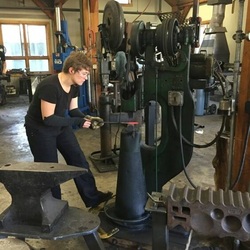
 Caitlin at the power hammer. John C Campbell Folk School Caitlin at the power hammer. John C Campbell Folk School I read an article about Lance Armstrong before his fall from grace. The article talked about how Mr Armstrong devoted all of his energy to biking; if he wasn't training, he was conserving his energy so that he could make the most of his next training session or his next race. I'd never thought of it that way. I thought of athletes as the folks who go out of their way to take the stairs. To lift the heavy thing. To go at top speed just because they can. But this article (I'm trying to track it down, please bear with me) asserted that Lance Armstrong takes the elevator.
Energy is a limited resource for all of us. For some, it's an extremely limited resource (see spoon theory). Sometimes folks (think: small children, people on certain legal and illegal substances, morning people) don't *seem* to have limits, but then things are quiet for a moment and you find that they've fallen asleep. It can be incredibly useful to keep in mind that there is a finite amount of work that can be accomplished in a day. (Okay, yes, I will acknowledge that some of you will find this thought very depressing. That doesn't make it less true, but if you need a minute, please take a minute. It gets better, I promise!) Alright! Glad to have you back! So here's the good news: Having limited energy, limited time, and only so much work you can accomplish in one day is a great reason to be LAZY. Yes, that's right. I think we should all be LAZY. But I think you should be lazy in order to get more done. Consciously choosing to do things that save you time and energy means that you can smith for longer.
Blacksmiths are a very resourceful group of folks. They are always on the lookout for ways to save time and energy. Send me your favorite lazy blacksmith tip ([email protected]) and I'll add it to the list!
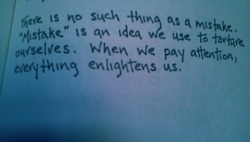 "There is no such thing as a mistake. 'Mistake' is an idea we use to torture ourselves. When we pay attention, everything enlightens us." --Cheri Huber, That Which You are Seeking is Causing You to Seek
My student swings the hammer and misses the mark. "I'm sorry!" the words leap to lips and spill out, dismay clearly evident. No one is injured. The hammer simply didn't fall in the right place. "No worries!" I say, "This is part of the learning process!" And I smile. Then we talk about how the metal reacted to the errant swing. I point out that something that was a "mistake" in one situation ends up being a "technique" in another. We discuss and move on. This scene has played out not once or twice, but dozens of times. And the dismay on my student's face secretly breaks my heart. It breaks my heart partly because making mistakes is a crucial part of learning to do something the right way. Niels Bohr said "An expert is a person who has found out by his own painful experience all the mistakes that one can make in a very narrow field." It's not a snappy quotation, (and ohmygosh, implying only men can be experts!!) but look at him allude to "painful experience". Look at how he talks about "all the mistakes". Learning can be really hard, folks. My students want to learn, be successful, do amazing things, but there is a crushing fear of making mistakes. But each mistake can be a treasure trove of learning, if we pay attention. Errors are inevitable, but an experienced smith can identify errors early on, and fix them before they become problems. And how do you become an experienced smith? Well, you make all the mistakes there are to make. (And you watch others make mistakes and fix them. And you read about others making mistakes and fixing them. And you try different fixes to the same mistake. And on and on and on.) Mistakes and their fixes are THE MOST IMPORTANT PART of learning. I work extra special hard to create a safe space for students to learn and explore. I'm here to help, to answer questions, to provide options, encouragement, and moral support, but students get to make --and fix-- their own mistakes. And that means that they are empowered to do their own troubleshooting, which makes them a better smith down the road. When I was first learning how to smith, there were a lot of well-meaning folks who tried to help me avoid making mistakes. I lost track of the number of times that someone took my hammer out of my hand and "fixed it" for me. This happened most memorably in the middle of a speed forging competition. Because of this, I became very interested in what I could learn from my mistakes, and I think I'm a better smith because of it.  PUFFINS!!! PUFFINS!!! I burned out last summer.
I probably don't have to describe the emotional exhaustion, the hopelessness, and the eternal frustration because burn-out is pretty common (http://www.statista.com/topics/2099/stress-and-burnout/). If you're not feeling burnt out yourself, it's likely that half of your friends could fill you in on what it's like. But this isn't a post about burn-out. It's a post about puffins. Normally when I travel, I research everything. But when I ended up in Iceland for a whirlwind business trip, I was completely unprepared. I found myself on top of a plateau overlooking black sand beaches at dusk, and I was astonished to see THOUSANDS of puffins perched on the cliff edge, riding the thermals, grooming each other, and hovering mid-air, wings invisibly flapping. Puffins, it turns out, flap their wings 400 times per minute (https://en.wikipedia.org/wiki/Puffin), which makes them look like little sad-eyed, colorful-beaked, torsos zooming about. Giant clown-faced humming birds. I recorded a little video of my unabashed excitement, but it was automatically deleted by my phone. I wish so fervently that I still had that clip because it captured the exact moment when I fell in love with the world again. (Okay, I found a fragment of a video from that day.) It's possible that I cried a little bit. It's possible that I hugged a random tourist. It's possible that I watched the birds until it was too dark to see them anymore. I wouldn't say that my life changed dramatically in that moment, but it reminded me how important it is to see and do new things. And then I ran into this article: http://www.nhs.uk/conditions/stress-anxiety-depression/pages/learn-for-mental-wellbeing.aspx I've noticed that doing new things helps me handle stress and depression better. It makes my world larger and more full of hope and possibility. If you're struggling right now, I hope that you find your puffin. Iceland should be on your short list--it's spectacular. But if you need something a bit closer to home (and home is within driving distance to Frederick, MD), I humbly offer my blacksmithing lessons. There is obviously no way that I can claim that blacksmithing treats stress, anxiety, or depression. And there's no way to predict whether you'll fall in love with it like I did. But it's widely believed that exercise helps mental-well-being, and you'll definitely get some exercise swinging a hammer. And you get to make art. And meet me, and I'll tell you all about the puffins in person. Caitlin It was 2009. I needed a hobby. I wrote down all the things I wanted to learn to do. And then I alphabetized the list. Because I'm that sort of person. Blacksmithing topped the list. I wasn't even sure that people still did blacksmithing. I had never seen anyone blacksmithing. A quick google search for "Blacksmithing classes" returned John C Campbell Folk School as the first hit. They have week-long and weekend classes. It was an 11-hour drive. I thought, "who takes a week's vacation to go learn blacksmithing?!" And I shut down my computer and headed out to lunch. And then I thought, "I do." I registered for my first class, told my boss that I was taking a week off to go learn blacksmithing, and have been smithing ever since. I haven't made it much past the "B's" in my wish list, but I've been enjoying the adventure! 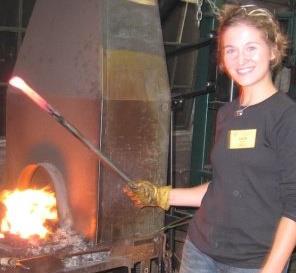
Caitlin as a newbie blacksmith at the John C Campbell Folk School.
I’ve noticed a trend on blacksmithing forums. A new smith asks a question about how to finish a project when they’re missing a crucial tool. The refrain is always the same: “blacksmiths make their own tools”.
It is one of the coolest things about blacksmithing. Indeed, it’s one of the best and least expensive ways to build your own shop and your hammer skills. Plus you get the satisfaction of custom-designing and using your own tools. During tong-making demonstrations, Lyle Wheeler (blacksmith, instructor, and chair-maker) will often call for a moment of silence for the smith who bravely reached into the fire bare-handed to make the first pair of tongs. The story always earns Lyle a chuckle. There are certainly ways to make tongs without tongs (and without burning your hands), but it’s not easy. It’s theoretically possible to trace the “ancestors” of your tongs back to ancient times, each set of tongs crafted by the set before. Smiths making tools for other smiths across generations. If you’ve got some time on your hands, try plotting out exactly how you’d get a blacksmithing shop together from scratch for real. I’ll be generous and start you off with an anvil. Need a hammer? Oh, gosh, you’ll have to make one. How do you get that hammer handle punched? It’s clearly possible to do if you’ve got the right environment. Maybe that stone doubles as a makeshift hammer. Maybe you cast a hammer with some clay and sand. Humans are smart and creative and good at using their environment to bootstrap their way into making more efficient tools. Making your tools from scratch can take a considerable amount of time, knowledge, and resources in your environment. Carl Sagan says, “If you wish to make an apple pie from scratch, you must first invent the universe.” Consider the simple punch; just a small bit of steel, a taper, a flat face, and rounded striking end. You may find that in addition to the tool-steel, you need an anvil, anvil stand, hammer, forge, forge stand, fuel, appropriately sized-tongs, hardy/chisel/other cutting device, a tempering chart, a magnet, something to polish the steel to see the colors run, something to quench with (also a quench bucket), a bin of vermiculite for slow cooling. You might want to have a vice and a set of files to clean it up. Maybe you’re lucky enough to have inherited a complete working shop, but for the rest of us, this list can be prohibitively long and expensive. These simple punches sell for $4.10 apiece on http://www.piehtoolco.com/ and a bag of vermiculite alone costs about $10. It has taken me years to collect the tools necessary to make my own tools. I haunted guild shops, befriended neighboring smiths, and shopped the tailgate sections at blacksmithing events. I learned so much from the smiths who taught me how to improvise with the tools I had, and I am eternally grateful to those who lent me their tools. Don’t get me wrong: making your own tools is arguably vital to becoming a good blacksmith, but the refrain of “blacksmiths make their own tools” fetishizes a self-sufficiency that is simply unrealistic for most beginning smiths. If you’re an experienced smith, please save that line for folks without any dirt under their fingernails. If you’re a new smith: don’t be afraid to buy, borrow, and improvise until you can make your own tools. Ask questions. Find teachers. Stop at nothing until you find a way to move forward. Welcome to the most amazing craft! We're glad to have you here! |
AuthorBlacksmith, instructor, mischief-maker. Archives
December 2025
Categories
All
|
 RSS Feed